What Is the UK Government EPC Register and Why Does It Matter?
· 7 min read
The UK Government EPC Register is the official database of Energy Performance Certificates for properties across England, Wales, and Northern Ireland. Learn what it is, why it exists, and how buyers, sellers, landlords, and investors use it.
If you have ever bought, sold, or rented a property in the UK, you have almost certainly encountered an Energy Performance Certificate. But behind every EPC sits a piece of infrastructure that most people know very little about: the Government EPC Register. It is one of the largest publicly accessible property databases in the country, and understanding it is increasingly important for homeowners, landlords, buyers, and property investors alike.
What Is the EPC Register?
The EPC Register is the official government database managed by the Ministry of Housing, Communities & Local Government (MHCLG). It holds every Energy Performance Certificate and Recommendation Report issued for properties in England, Wales, and Northern Ireland.
It is a free, public database that contains all valid EPCs issued since 2008, meaning anyone can search and view certificates at no cost. The records held include current energy ratings, numerical scores, historical EPCs for the same property, and official legal proof of energy performance.
In practice, the register acts as a central point of truth for the energy efficiency of the UK''s built environment — a permanent, searchable record that can be accessed by anyone with an internet connection, from a first-time buyer checking a flat to a researcher analysing national housing stock.
Why Was It Created?
The EPC Register did not appear overnight. It was created to support energy efficiency regulations. Since 2007, having an EPC has been a legal requirement when selling or renting most properties in England and Wales. The register provides the infrastructure to enforce and evidence that requirement.
The broader context is the UK government''s commitment to reducing carbon emissions from the built environment. Buildings account for a significant portion of national energy consumption, and property-level data was needed to understand the scale of the challenge, track progress, and set policy. The register solves that problem by creating a standardised, verifiable record across millions of properties.
The register is a public resource, holding both current and historical data, including the energy efficiency rating and suggested measures to enhance a property''s energy performance. This combination of transparency and historical depth makes it useful not only for compliance purposes but for genuine decision-making.
What Does an EPC Actually Tell You?
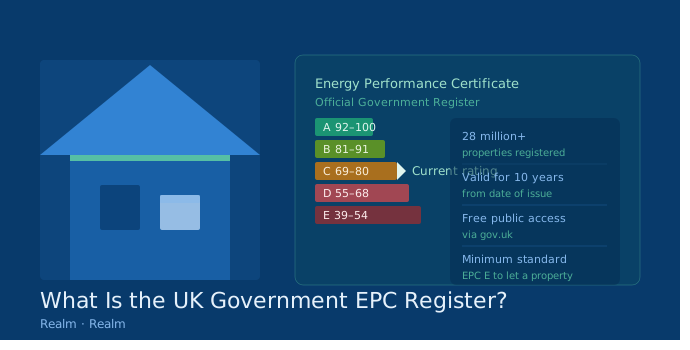
An Energy Performance Certificate rates a property on a scale from A to G, where A is the most efficient and G the least. The ratings break down as follows: A (92–100) is most efficient, typically found in new builds with solar panels; B (81–91) covers very efficient, well-insulated modern homes; and C (69–80) is broadly considered good — and is the government''s target for rental properties.
Beyond the headline rating, a certificate includes details about a property''s current energy systems — insulation, heating, windows, and hot water — along with a set of recommended improvements and their estimated impact on the rating. This makes it a practical tool, not just a compliance document.
EPCs are valid for 10 years from the date of issue. After a decade, or when significant energy improvements have been made, a new assessment is required.
Who Uses the EPC Register — and How?
The register is used by a wide range of people across the property market.
Buyers and sellers use it to verify a property''s current certificate, understand likely energy running costs, and avoid any compliance issues before a transaction completes. In the UK, property owners are legally required to have a current Energy Performance Certificate when selling, renting out, or constructing a building.
Landlords rely on it to demonstrate compliance with the Minimum Energy Efficiency Standards (MEES), which currently require any privately rented property to hold at least an E rating before it can be let. Landlords must provide a copy of the valid EPC to prospective tenants before they move in, and those who fail to comply can face fines of up to £5,000 per property.
Tenants can use the register to check a property''s rating before signing a lease, giving them a clearer picture of likely utility bills and the landlord''s compliance standing.
Property investors and analysts use the register''s bulk data to assess portfolio exposure, identify improvement opportunities, and model the impact of incoming legislation. Estate agents, letting agents, mortgage providers, and potential buyers often refer to EPC data to make informed decisions. The government also uses EPC statistics to track housing stock efficiency and inform policy.
The Scale of the Register
The data held in the register is substantial. In the quarter July to September 2025 alone, 436,000 Energy Performance Certificates were lodged on the Energy Performance of Buildings Register for both domestic and non-domestic properties in England and Wales. That gives a sense of the ongoing volume of activity flowing through the system.
In that same quarter, 85% of new dwellings were given an A or B rating — a reflection of tightening building regulations for new construction. Existing stock tells a very different story, with large numbers of properties still sitting in the lower bands, particularly in the private rented sector.
Why It Matters More Than Ever
The register has moved from a background compliance tool to a central piece of the UK''s housing policy landscape. Following the government''s Warm Homes Plan, confirmed on 21 January 2026, all private rented properties in England and Wales must reach EPC Band C by a single compliance date of 1 October 2030, covering both new and existing tenancies.
The penalties for non-compliance are also rising sharply — fines of up to £30,000 per property are planned under the new rules, up from the previous maximum of £5,000.
To meet the 2030 target, it is estimated that each year around 340,000 rental homes will need to make improvements to achieve a minimum EPC rating of C. The register is the instrument through which all of that progress — or lack of it — will be measured and enforced.
How to Access It
Accessing the EPC Register is straightforward. To find an EPC, simply enter the property''s address or Report Reference Number (RRN) into the EPC register search tool on gov.uk. If an EPC has been issued in the last 10 years, it should appear instantly.
The search is free, requires no registration, and returns the full certificate including the current rating, the potential rating if all recommended improvements were made, and the specific recommendations themselves. For property professionals and data users, bulk data downloads are also available through the government''s open data portal.
The Bigger Picture
For anyone working in property — whether buying, selling, letting, investing, or advising — the EPC Register is no longer a document you glance at and file away. It is a live indicator of regulatory exposure, a data source for investment decisions, and increasingly a factor in mortgage lending and insurance.
At Signals BI, EPC data sits at the heart of our property intelligence reports, giving users postcode-level insight into energy efficiency patterns across England and Wales. Understanding where the register comes from, what it contains, and how it is used is the first step in making that data work for you.