What Does It Mean to Flip a House? UK vs USA — Terms, Strategies and How It Really Works
· 10 min read
House flipping means buying a property to renovate and resell at a profit. But the way it works in the UK and USA are worlds apart. This guide explains the terms, strategies, deals, and real numbers behind property flipping in both markets.
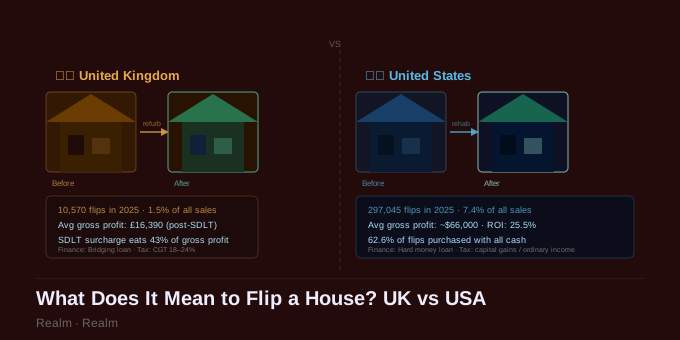
Walk into any conversation about property investment and the word "flipping" will come up quickly. It sounds straightforward — buy low, renovate, sell high — but the reality in both the UK and the United States is considerably more nuanced. The costs, culture, terminology, tax treatment, and deal structures differ significantly between the two markets, and understanding those differences matters whether you are a curious observer or an active investor.
Contents
- What is house flipping?
- The core vocabulary — a UK and USA glossary
- Types of flip deals
- How flipping is financed
- The numbers: what flipping actually makes in 2025–26
- The tax reality — where UK and USA diverge sharply
- Strategies and deal structures
- Where flipping works best — and where it does not
- Is flipping worth it today?
1. What Is House Flipping?
At its most basic, house flipping is the practice of purchasing a property with the intention of selling it quickly — typically within twelve months — at a higher price than you paid. The profit, if there is one, comes from some combination of three sources: a below-market purchase price, value added through renovation, and rising market conditions during the hold period.
The strategy is well established in both the UK and USA, though its cultural footprint is far larger in America, where television shows have built an entire genre around the concept. In the UK, it operates more quietly — practised by professional developers, experienced landlords, and specialist investors rather than the mainstream.
What both markets share is the fundamental logic: find an undervalued or neglected property, improve it cost-effectively, and sell it to an end buyer — typically a homeowner — at a price that reflects the improved condition and market value.
2. The Core Vocabulary — a UK and USA Glossary
Understanding flipping in either market starts with the language. Many terms cross the Atlantic but carry slightly different meanings or equivalents.
After Repair Value (ARV) — Used in both markets. The ARV is the estimated market value of a property after all planned renovation work has been completed. It is the central number around which every deal is modelled. In the UK, this is sometimes referred to as the Gross Development Value (GDV) for larger projects.
The 70% Rule — A widely used acquisition rule in both markets. It states that an investor should pay no more than 70% of the After Repair Value of a property, minus estimated repair costs. So if a property's ARV is £200,000 and refurbishment will cost £30,000, the maximum purchase price under the 70% rule would be £110,000. The rule exists to protect margin — buying below this threshold builds in a buffer for cost overruns, holding costs, and transaction fees.
Fix and Flip — The standard American term for the core flipping strategy: buy a distressed property, renovate it, sell it. The term is widely used by lenders and investors. In the UK, the equivalent phrase is more commonly "refurbish and sell" or simply "a flip," though fix and flip is increasingly heard.
Hard Money Loan (USA) — A short-term, asset-backed loan used by US flippers to finance acquisitions quickly. Hard money lenders prioritise the property's ARV over the borrower's credit profile, making them accessible to investors who would not qualify for conventional bank finance. Interest rates are high — typically 10–15% annually — but speed of approval is the key advantage.
Bridging Loan (UK) — The direct UK equivalent of a hard money loan. Bridging loans are the financing method of choice for many UK property developers and investors as they are easier and faster to obtain than traditional mortgages, though they carry higher interest rates due to their short-term nature — generally between three and 24 months. UK bridging rates typically run at 0.5–2% per month.
Wholesale (USA) — A deal structure where an investor contracts to buy a property and then assigns that contract to another buyer for a fee, without ever completing the purchase or doing any renovation. Wholesaling is common in the USA but has no direct equivalent in UK conveyancing law, where contracts work differently.
Light, Medium, and Heavy Refurbishment (UK) — UK bridging lenders categorise renovation projects into light (cosmetic improvements requiring no planning permission), medium, and heavy (significant structural changes requiring planning permission and building regulations approval). The category affects loan terms and conditions. US lenders use similar categories — cosmetic, moderate, and full rehab — though the terminology varies by lender.
BRRRR (USA and increasingly UK) — Buy, Rehab, Rent, Refinance, Repeat. A longer-term strategy where the investor renovates a property, tenants it out, refinances against the improved value to pull out capital, and uses that capital to repeat the process. It is not strictly flipping — the property is retained rather than sold — but it overlaps significantly in the acquisition and renovation phases.
Stamp Duty Land Tax / SDLT (UK) — The purchase tax levied on UK property transactions. For investors buying a second property, a surcharge applies on top of standard rates. This is one of the most significant structural differences between the UK and US markets, and a major reason flipping is harder in Britain.
Capital Gains Tax / CGT (UK) and Capital Gains / Ordinary Income (USA) — The tax applied to profit on the eventual sale. In both markets, tax treatment is a crucial part of deal modelling.
3. Types of Flip Deals
Not all flips are the same. The type of deal shapes the risk profile, the timeline, and the likely return.
Cosmetic flip — The most accessible entry point. The property is structurally sound but aesthetically tired: dated kitchens and bathrooms, tired décor, overgrown gardens, tired carpets. Work is relatively straightforward, costs are lower, and planning permissions are not required. Margins tend to be thinner but so does the risk.
Structural or heavy refurbishment flip — The property requires significant work: rewiring, replumbing, roof replacement, damp treatment, structural repair, or extension. These projects carry higher potential uplift but also higher cost risk, longer timelines, and greater exposure to unexpected findings. In the UK, any work that alters the structure of a building or its services requires approval under Building Regulations.
Distressed or vacant property flip — There are currently believed to be around 1.5 million homes left vacant in the UK. These properties — often uninhabitable, sometimes in probate or repossession — can be acquired significantly below market value precisely because they are unmortgageable. They carry the highest execution risk but, done correctly, the strongest margins.
Auction flip — Properties sold at auction frequently fall into the distressed or unmortgageable category, and auction purchases must complete within 28 days. This creates a natural home for bridging finance, which can move quickly enough to meet auction timelines. When you buy a property at auction, you are working to two tight deadlines: 28 days to complete the purchase, and however long the renovation takes. In the USA, foreclosure auctions play a similar role, with investors acquiring distressed bank-owned properties at courthouse steps.
Wholesale deal (USA-specific) — Wholesaling involves finding distressed properties and assigning contracts to other investors for a fee, without completing renovation. It delivered an average profit of around $29,600 per deal in 2024 — lower than fix and flip, but with none of the renovation risk or capital requirement.
4. How Flipping Is Financed
Financing is where the UK and US markets diverge most practically.
In the UK, the dominant instrument is the bridging loan. Bridging loans can be approved far more quickly than regular mortgages, and funds can be received in a matter of weeks or even days. Crucially, many properties that are perfect for flipping — those in poor condition, without a working kitchen or bathroom — cannot be financed with a traditional mortgage. A bridging loan is secured against the property's current value and the investor's exit strategy, making it suitable for these types of projects.
In the USA, the equivalent is the hard money loan, supplemented by a mature market of specialist "fix and flip" lenders offering rehab loans — products that fund both the acquisition and the renovation costs, releasing funds in stages as work is completed. Approximately 62.6% of flipped homes in the USA were purchased with all cash in 2025, reflecting the dominance of well-capitalised professional investors in that market.
Both markets also see joint venture partnerships, where an investor with deal-finding or renovation skills partners with a capital provider who supplies the funds in exchange for a share of profit.
5. The Numbers: What Flipping Actually Makes in 2025–26
The data tells a striking story in both markets — and it is not as glamorous as television would suggest.
In the UK, flipping has been squeezed hard by rising transaction costs. In 2025, just 1.5% of all property transactions in England and Wales were flips — down from 2% the year before — marking the continuation of a slowdown that began after the second home stamp duty surcharge was introduced in 2016. The number of homes flipped has halved from 21,560 in 2016 to 10,570 in 2025.
The average post-SDLT gross profit on a flipped home fell from £36,500 in 2015 to £16,390 in 2025 — a 55.1% decline. That figure excludes refurbishment costs entirely, suggesting that only a minority of flipped properties ultimately deliver a meaningful net profit.
Profitability has fallen most sharply in southern regions, where stamp duty costs are higher and house price growth has been weaker. The North East recorded the strongest returns — averaging 36.4% — and was the only region where post-SDLT profits rose over the decade. Stamp duty in the North East averages around £6,000 per flipped property, compared with approximately £30,000 in London.
In the USA, the picture is similarly challenged, though from a higher base. Home flipping activity slowed in 2025 as investors faced tightening margins, with returns dropping to 25.5% — the lowest level since the Great Recession — despite record home prices. Flips made up 7.4% of all home sales, and profits declined across most markets.
The average gross profit on a US flip in 2025 was approximately $66,000, with an average time to complete a flip of around 166 days. However, this figure — like its UK equivalent — excludes renovation and holding costs, which experienced US flippers estimate at 20–33% of a property's after-repair value.
6. The Tax Reality — Where UK and USA Diverge Sharply
Tax is arguably the single biggest differentiator between the two markets for anyone considering flipping seriously.
In the UK, two taxes bite: Stamp Duty Land Tax on purchase, and Capital Gains Tax on profit. SDLT now costs the average person flipping a home in England and Wales a record 30% of their gross profit before any money has been spent on improvement works. CGT on residential property is charged at 18% or 24% depending on income tax band, applied to the net profit after allowable costs.
In the USA, the tax treatment depends on how frequently you flip. If you are flipping houses regularly, the IRS may classify you as a real estate dealer rather than an investor. This means your profits are treated as ordinary income rather than capital gains — which can significantly increase the tax burden. Occasional flippers may qualify for the more favourable long-term capital gains rate if they hold a property for more than a year, but the short timelines involved in most flips make this difficult to achieve.
7. Strategies and Deal Structures
Beyond the basic buy-renovate-sell model, experienced investors in both markets use more sophisticated approaches.
The BRRRR Strategy — Popular in both markets among investors who want to build a portfolio rather than generate short-term income. The BRRRR model works when all-in costs — purchase plus renovation — are kept to 70–75% of the ARV, allowing a refinance at 75–80% loan-to-value that recovers most or all of the original capital, which is then recycled into the next deal.
Off-market sourcing — Flippers who use creative financing or off-market deals consistently outperform those relying on portal inventory. In both the UK and USA, the best-margined deals are rarely listed publicly — they come through agent relationships, direct mail campaigns, probate leads, and distressed seller networks.
Portfolio flipping — Running multiple projects simultaneously to spread fixed costs (management, professional fees, finance setup costs) across more deals. This requires more capital and project management capability but improves overall returns.
8. Where Flipping Works Best — and Where It Does Not
In the UK, the data points clearly. Properties priced below £100,000 were the most likely to turn a profit in 2025, with 86% doing so. This fell sharply to just 28% of properties bought for more than £350,000. The North East, Yorkshire, and parts of the North West offer the most viable conditions — lower purchase prices, lower stamp duty bills, and in some cases stronger relative price growth.
Flats and terraced houses remain the most popular targets, making up 44.86% and 32.27% of UK flips respectively — offering a sweet spot of purchase price and potential uplift.
In the USA, markets like Cleveland, Buffalo, and Detroit show cash-buyer dominance above 76%, reflecting strong investor activity in affordable markets with older housing stock and high rental demand — conditions that also support the BRRRR model.
In both markets, high-value locations — London and the South East in the UK, coastal California and Manhattan in the USA — have become increasingly unviable for flipping due to the combination of high acquisition costs, stamp duty or property transfer taxes, and compressed price growth.
9. Is Flipping Worth It Today?
The honest answer, in both markets, is: it depends — and the margin for error has narrowed significantly.
As Hamptons head of research Aneisha Beveridge summarised: "Flipping is no longer the profitable venture it once was. There was a time when rundown properties could be bought cheaply, refurbished, and resold at a healthy margin. Today, however, second home stamp duty absorbs nearly half of all gross profits, significantly eroding returns."
That does not mean flipping is dead — it means it requires far more discipline than it did five or ten years ago. The investors who are still making it work are buying deeper below market value, controlling renovation costs tightly, sourcing off-market, and focusing on regions where the numbers still make sense.
Data matters more than ever. Understanding price trends at postcode sector level, modelling stamp duty and CGT costs before making an offer, and checking comparable sold prices to validate the ARV — these are the foundations of any flip that has a genuine chance of succeeding.
Want postcode-level price trend data to model your next flip? Start your free trial at signalsbi.com and generate your first property intelligence report today — no commitment required.
Frequently asked questions
What is house flipping?
House flipping is the practice of buying a property, typically below market value, renovating it, and reselling it at a profit, usually within twelve months. Profit comes from a below-market purchase price, value added through renovation, and market price growth during the hold period.
What is the 70% rule in house flipping?
The 70% rule states an investor should pay no more than 70% of a property’s After Repair Value (ARV) minus estimated repair costs. For example, if the ARV is £200,000 and refurbishment costs £30,000, the maximum offer is £110,000. It builds in a margin for cost overruns, holding costs, and fees.
How is flipping financed in the UK versus the USA?
In the UK, bridging loans are the dominant instrument — short-term, asset-backed finance approved quickly and suitable for unmortgageable properties, typically at 0.5–2% per month. In the USA, the equivalent is hard money lending, usually at 10–15% annual interest, alongside specialist fix-and-flip rehab loans that fund acquisition and renovation in stages.
Is house flipping still profitable in the UK in 2025?
It is significantly harder than a decade ago. Only 1.5% of UK property transactions in 2025 were flips, and average post-SDLT gross profit fell to £16,390 — a 55.1% decline since 2015 — before refurbishment costs. The North East remains the strongest region, while London and the South East are largely unviable due to stamp duty and weak price growth.