What Are Property Comps? A Step-by-Step Guide to Comparative Analysis in UK Real Estate
· 7 min read
Property comps are the foundation of accurate valuations in UK real estate. Learn what comparables are, how to find them, and how to run a proper comparative market analysis — step by step.
Whether you are buying your first home, selling an investment property, or building a portfolio, one skill sits at the heart of every sound property decision: the ability to assess what a property is actually worth. That skill is built on comps.
Comps — short for comparables — are the bedrock of property valuation. Understanding how to find them, filter them, and use them correctly can mean the difference between a shrewd deal and an expensive one.
1. What Are Property Comps?
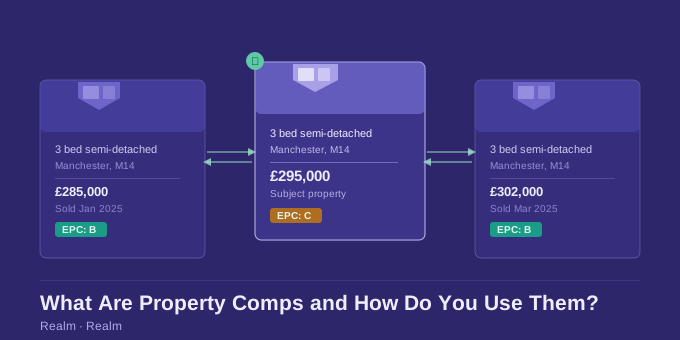
Comparables are recently sold properties with similar characteristics to the property being evaluated. By comparing location, size, features, and sales price, comps provide a benchmark for estimating what a property is worth in the current market. [Goliathdata]
In the UK, the term is used interchangeably with "comparable evidence" or "comparable sales." When an estate agent prepares a valuation, a surveyor carries out a RICS assessment, or a mortgage lender instructs a valuation report, they are all drawing on the same principle: what have genuinely similar, nearby properties actually sold for, recently?
The output of this process — a structured analysis of several comparable transactions — is commonly called a Comparative Market Analysis, or CMA. A CMA involves professional judgement about which properties are truly comparable and what price adjustments are warranted for differences in size, condition, location, and features. [Effective Agents]
It is worth noting what comps are not. They are not asking prices, estimated valuations from automated tools, or what a seller hopes to achieve. They are completed transactions — real prices paid by real buyers in arm's-length sales.
2. Why Comps Matter — and Who Uses Them
Determining the fair market value of a property is one of the most critical steps in any real estate transaction. Whether buying, selling, refinancing, or investing, having an accurate property valuation ensures fair negotiations and protects financial interests. [Goliathdata]
Comps are used across the board:
- Sellers use them to price a property competitively without leaving money on the table or setting expectations so high that the listing stagnates.
- Buyers use them to frame offers with confidence and push back against inflated asking prices.
- Landlords and investors use them to assess yield relative to acquisition cost and to rank opportunities across a market.
- Mortgage lenders use them to validate that the purchase price is supported by comparable evidence before approving a loan.
Banks and mortgage brokers rely on comps to validate loan-to-value ratios and to assess risk. A well-documented set of comparable sales strengthens a valuation narrative and reduces the need for excessive contingencies. [Quickassist247]
3. Step 1 — Define Your Subject Property
Before you can find comparable sales, you need a precise description of the property you are trying to value. At a minimum, record:
- Property type: detached, semi-detached, terraced, or flat
- Floor area: in square metres where possible
- Number of bedrooms and bathrooms
- Tenure: freehold or leasehold
- Condition and any recent improvements: new kitchen, extension, roof replacement
- EPC rating: increasingly important given incoming MEES requirements
- Location specifics: postcode sector, proximity to transport, schools, amenities
The more precisely you can define the subject property, the easier it becomes to identify genuinely comparable sales — and the more defensible your eventual valuation will be.
4. Step 2 — Find Comparable Sales
In the UK, the primary source of sold price data is HM Land Registry. After every registered property transaction in England and Wales completes, HMLR publishes the sale price, address, date, property type, and tenure as part of its Price Paid Dataset. [Property Passport UK] This data is publicly available and free to access.
Major property websites like Rightmove and Zoopla pull their sold house price information straight from Land Registry. HM Land Registry registers over 100,000 home sales each month, making it one of the most comprehensive property databases available. [Boom]
In practical terms, your main UK data sources are:
- HM Land Registry Price Paid Data — the primary source, available directly at gov.uk or via bulk download
- Rightmove Sold Prices — useful for linking sale prices to listing photos and descriptions, giving context to the numbers
- Zoopla — integrates Land Registry data alongside automated estimates and area market data
- Signals BI property intelligence reports — postcode-sector level price trends, transaction histories, and market data in a single report
Start by searching for sales within the same postcode sector as your subject property, then widen your search radius only if insufficient comparable evidence exists nearby.
5. Step 3 — Filter and Select Your Best Comps
Not every nearby sale is a useful comp. The goal is to find transactions that are as similar as possible to your subject property across four key dimensions:
Location — Comps should ideally be in the same neighbourhood or within a short distance from the subject property. [Innago] In dense urban areas, this might mean the same street or postcode. In rural areas, you may need to cast a wider net, but always note and account for any locational differences.
Recency — For a rigorous analysis, adjust for date-related market shifts to a common reference point, such as a six-month or twelve-month window. [Quickassist247] Sales older than 12 months carry increasing risk of reflecting a different market environment. In a fast-moving market, even six months can be significant.
Property type and size — A terraced house is not a comp for a semi-detached. A 60 sq m flat is not a comp for a 90 sq m flat on the same street. The more similar the properties are in location, quality, and size, the more confidence you can have in the value estimate. [Altus Group]
Condition and tenure — A recently renovated property and an unrenovated one will command meaningfully different prices even if identical in every other respect. Similarly, leasehold flats with short leases require careful handling.
Aim to identify three to five strong comps. Fewer than three leaves your analysis exposed; more than five can introduce noise if you are forced to reach for weaker comparables to fill the set.
6. Step 4 — Adjust for Differences
In practice, no two properties are perfectly identical. The adjustment step is where you account for the differences between each comp and your subject property, arriving at an adjusted price that better reflects what each comparable would have sold for if it were your subject property.
Common adjustments cover: size and layout (amending for any excess or deficiency in floor area or room configuration); condition and renovations (factoring in improvements such as kitchens, bathrooms, or extensions, or deferred maintenance); floor level, views, parking, and access (a prime corner plot, a superior view, or a driveway can swing values); and market timing (if a comp sold in a hotter or cooler market, apply a time adjustment to align with the subject's valuation date). [Quickassist247]
A straightforward way to apply adjustments is to normalise all comps to a price per square metre, then add or subtract a monetary amount for material differences. For example, if a comparable property has off-street parking and your subject does not, and local evidence suggests parking adds approximately £8,000 of value, you deduct that amount from the comparable's adjusted price.
Once you have identified and selected your comparison properties, methods such as paired data analysis, trend analysis, and cost analysis can be used to determine adjustment amounts. [Privy] For most buyers and investors, a straightforward per-square-metre calculation combined with reasoned judgement on key features is sufficient.
7. Step 5 — Arrive at a Value Range
Once your comps are adjusted, arrange them in a simple table showing the original sale price, the key adjustments made, and the resulting adjusted price. Your subject property's estimated value will sit within the range defined by your adjusted comps — weighted towards the most similar transactions.
Resist the temptation to average mechanically. Give more weight to the comps that required the fewest adjustments, that sold most recently, and that are located closest to your subject property. The result should be a value range — for example, £280,000 to £310,000 — rather than a single figure, which gives an honest representation of the evidence.
8. Common Mistakes to Avoid
Using asking prices as evidence. Asking prices reflect seller ambition, not market reality. Only completed transactions count.
Ignoring property type. Sold price data on the main portals comes from HMLR Price Paid Data [Property Passport UK], but it does not automatically filter by property type. Ensure you are not mixing flats with houses, or freeholds with leaseholds.
Stretching the time window too far. A sale from three years ago tells you very little about today's market, particularly in areas that have seen significant price movement.
Overlooking condition. A seller who compares an outdated home to a fully remodelled one nearby is using invalid comps. [Highnote] Condition differences must always be reflected in your adjustments.
Relying solely on automated valuations. Automated valuation tools work best where there are many recent comparable sales of standardised properties. They work worst where the property is unusual or the local market is illiquid. [Property Passport UK] Use them as a first sanity check, not as a substitute for manual comparable analysis.
9. Tools and Data Sources in the UK
| Source | What It Provides |
|---|---|
| HM Land Registry Price Paid | Complete sold price records for England & Wales |
| Rightmove Sold Prices | HMLR data with listing photos and history |
| Zoopla | HMLR data with automated estimates and area context |
| Signals BI | Postcode-sector price trends, transactions, and market intelligence |
| Registers of Scotland (ScotLIS) | Equivalent data for Scottish properties |
For property investors and professionals who need to analyse patterns across multiple postcodes — rather than one property at a time — postcode-sector intelligence reports provide a faster, more structured view of the market.
Done well, a comparative market analysis is one of the most powerful tools available to anyone operating in property. It grounds decisions in evidence, removes emotion from pricing, and puts you in a stronger position whether you are buying, selling, or holding. The data is largely free and publicly accessible in the UK — the skill lies in knowing how to use it.
Want to understand price trends and transaction data for any postcode sector in England and Wales? Start your free trial at signalsbi.com and generate your first property intelligence report today — no commitment required.