Subscription vs Pay-As-You-Go: Which Is Better Value for Property Report Software?
· 10 min read
Many property data platforms lock you into monthly subscriptions with credits you may never use. This guide breaks down the honest pros and cons — and explains why pay-as-you-go often makes more financial sense for most property buyers, sellers, and investors.
If you have ever looked for property market data online, you will know the drill. You find a platform that looks useful, click through to pricing, and discover that to access anything meaningful you need to commit to a monthly or annual subscription — often with a bundle of credits attached. Use the credits, and the per-report cost can seem reasonable. Do not use them, and you have effectively paid for something you never received.
The subscription model dominates the software industry for a reason: it generates predictable, recurring revenue. But that is a benefit to the company, not necessarily to you. When it comes to property data — reports you need on a property-by-property or area-by-area basis — the question of whether a subscription is actually worth paying deserves a clear-eyed answer.
1. How Property Data Software Is Typically Priced
Property data platforms tend to use one of two broad pricing models, or a hybrid of the two.
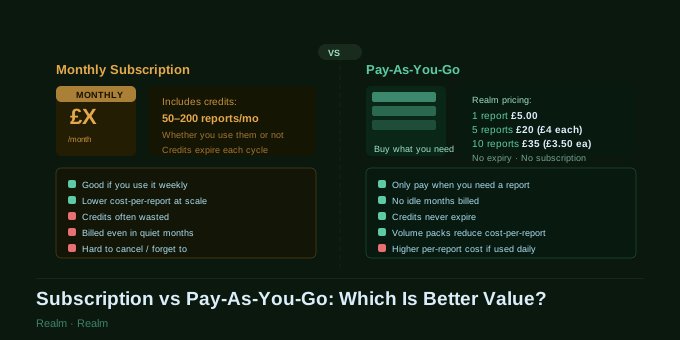
Subscription with credits — You pay a fixed monthly or annual fee in exchange for a set number of reports or lookups per billing cycle. This is the most common model in the market. Credits are typically allocated at the start of each billing period and, in most cases, expire at the end of it whether or not you have used them. The more you pay per month, the more credits you receive — and the lower the implied cost per report.
Pay-as-you-go — You purchase reports individually, or in bundles, without any ongoing commitment. You use what you buy, and if you need more, you buy more. Signals BI operates on this model: a single report costs £5, a pack of five costs £20 (£4 each), ten reports costs £35 (£3.50 each), and twenty reports costs £60 (£3 each). Credits do not expire.
Both models have their place. The question is which one genuinely serves the needs of the person paying for it — and that depends entirely on how often and how consistently you actually use property data.
2. The Case for Subscriptions — When They Genuinely Make Sense
It would be dishonest to dismiss subscriptions entirely. For a specific type of user, they can represent excellent value.
High-volume professionals — Estate agents running valuations daily, mortgage brokers processing multiple applications a week, or property analysts covering large portfolios may generate enough activity to justify a subscription comfortably. If you are running twenty or thirty postcodes or property checks every month without fail, a subscription that brings your cost per report down significantly has a clear logic.
Teams with shared access — Many subscription platforms allow multiple users under one account, which changes the economics considerably. Divide a monthly fee across three or four team members who each need regular access and the per-person cost can become very reasonable.
Regular market monitoring — If your business model involves tracking price trends in a defined set of areas over time — a developer monitoring land values, for instance, or a regional investor tracking specific markets — the consistency of a subscription can suit the consistency of the need.
The key word throughout all of this is consistency. Subscriptions reward regular, predictable use. They penalise irregular, occasional, or seasonal use — and that describes the majority of people who buy property data.
3. The Hidden Costs of Subscription Models
Before committing to a recurring payment for property data software, it is worth understanding where the real costs sit — because they are not always where you expect.
Unused credits are lost money. This is the most straightforward risk. If a subscription gives you fifty reports per month and you use ten, you have paid for forty reports you never received. That is not a minor inconvenience — over twelve months it adds up to paying for nearly five hundred reports while using just over a hundred. The effective cost per report climbs steeply once you account for waste.
Your usage is seasonal and irregular. Most people''s need for property data does not arrive on a monthly schedule. A buyer researches intensively for three or four months, then stops. An investor runs analysis ahead of a purchase, then goes quiet for six months. A landlord checks market conditions once or twice a year. A subscription charges the same amount during a quiet month as during an active one.
Annual commitments create lock-in. Many platforms offer a lower monthly rate if you pay annually upfront. That sounds attractive until you consider that your property search may conclude in month four, leaving you paying for eight months of unused access. The savings per month are real; the total cost may not be.
Features you do not need inflate the price. Subscription tiers are often structured so that the features you actually want sit in a higher tier than you strictly need. You end up paying for a bundle of capabilities — API access, team seats, bulk downloads — that you will never use, simply to unlock the report type that matters to you.
Cancellation friction is a deliberate design choice. The subscription software industry has a well-documented problem with cancellation. Platforms make it easy to sign up and effortful to leave — through long notice periods, the need to contact customer service, or the psychological pull of credits you have not yet spent. It is not an accident.
4. The Case for Pay-As-You-Go
The pay-as-you-go model is simpler, more transparent, and — for most users — more honest about what they are actually buying.
You identify a property or area you need data on. You purchase a report. You use it. If you need another one next week, you buy it. If you do not need another one for three months, you pay nothing for three months.
This is how most professional services work. You do not pay a monthly retainer to a solicitor on the off chance you might need legal advice — you instruct them when you need them. Property data is no different for the majority of buyers, investors, and advisers in the market.
At Signals BI, the pay-as-you-go model was a deliberate choice built around the way most people actually use property intelligence. The reality is that a first-time buyer researching a shortlist of areas needs perhaps five to ten reports over the course of their search — not fifty a month. A buy-to-let investor evaluating three potential acquisitions needs three reports, not a hundred. A homeowner curious about their area''s price trends needs one.
Buying a pack of ten Signals BI reports at £35 gives you comprehensive property intelligence at £3.50 per report — with no expiry date on the credits, no subscription to cancel, and no idle months billed to your card. You use what you need, when you need it.
5. Who Uses Property Reports — and How Often?
To think clearly about which pricing model suits you, it helps to be honest about who is actually buying property data and how frequently they genuinely need it.
Home buyers and sellers are the largest group of property data users. They are intensely active for a defined period — typically two to six months — and then largely dormant. During the active phase, they might run several postcode or area reports. During the rest of the year, they need nothing. A subscription charges them twelve months for a four-month need.
Buy-to-let investors and portfolio landlords tend to cluster their research activity around acquisition decisions. An investor adding one or two properties per year might need significant data in the months leading up to each purchase, and relatively little in between. Again, the pattern is peaks and troughs rather than consistent monthly demand.
Property developers may represent a better fit for subscriptions if they are actively sourcing sites at scale. However, smaller developers working on one or two projects at a time will find their data needs follow the project cycle, not the calendar.
Estate agents and mortgage brokers are the group most likely to find genuine value in subscription models, provided the platform integrates meaningfully into their daily workflow and the credits are actually consumed. For everyone else, the honest answer is that consistent monthly usage is the exception, not the rule.
6. Running the Numbers: A Practical Comparison
Let us put actual figures against the two models to see how the value comparison plays out in practice.
Suppose you are a property investor who researches two to three potential acquisitions per quarter — meaning roughly eight to twelve property intelligence reports per year.
Under a typical subscription model — even a modest monthly plan — you are paying twelve months of fees regardless of usage patterns. If the subscription costs £15 per month, that is £180 per year for a need that generates perhaps ten reports. The implied cost per report used is £18 — significantly higher than the headline cost-per-credit the subscription advertises.
Under Signals BI''s pay-as-you-go model — a pack of ten reports at £35 covers the same annual need at £3.50 per report. That is a total outlay of £35 to £70 for the year, compared with £180 under a subscription. The credits do not expire, so any unused reports carry forward to your next purchase decision.
The numbers shift at the top end. A professional running thirty or more reports every single month may find a subscription brings their cost per report below what pay-as-you-go offers. But for the vast majority of buyers, sellers, and investors who use property data intermittently, the maths heavily favours paying for what you use.
7. What to Look for in a Pay-As-You-Go Property Platform
Not all pay-as-you-go property data platforms are equal. If you are evaluating options, these are the questions worth asking.
Do credits expire? Expiring credits are the pay-as-you-go equivalent of the subscription trap — they create artificial urgency and push you towards over-purchasing. Signals BI credits do not expire.
Is there volume pricing? A good pay-as-you-go platform rewards you for buying in sensible quantities without punishing you if you do not use everything at once. Volume packs — like Signals BI''s five, ten, and twenty report tiers — bring the per-report cost down incrementally as you scale up.
What is actually in the report? The price per report is only meaningful if the report delivers the data you need. Signals BI Area Intelligence Reports cover price trends, transaction history, demographics, EPC ratings, planning data, flood risk, broadband coverage, and local amenity context at postcode sector level — the full picture in a single document.
Is there a trial or introductory report? The best way to assess whether a platform''s reports meet your needs is to run one before committing to a larger purchase. Signals BI offers a free first preview so you can evaluate the quality and depth of the data before spending anything.
8. The Honest Conclusion
The subscription model exists because it is excellent for the businesses that sell it. It generates reliable revenue regardless of whether the customer actually uses the product consistently. That is a business benefit, not a customer one.
For most people in the property market — buyers, sellers, landlords, investors, advisers — usage is clustered, seasonal, and driven by specific decisions rather than ongoing routine. Paying a monthly fee for twelve months to cover a need that peaks for three or four months and requires perhaps ten to twenty reports in total is rarely the best use of money.
Pay-as-you-go is not right for everyone. If you are a high-volume professional running dozens of reports every single month without interruption, a subscription may well deliver a lower cost per report. But if you are honest about your actual usage — not your theoretical maximum — the answer for most people is simpler: buy what you need, when you need it, and do not pay for what you do not.
At Signals BI, that is precisely what the pricing is designed to allow. One report for £5. Five for £20. Ten for £35. Twenty for £60. No subscription. No expiry. No idle billing.
Ready to try it yourself? Generate your first Area Intelligence Report at signalsbi.com — no subscription required, no commitment, no credits that expire.
Frequently asked questions
Is a property data subscription worth it for a single home buyer?
For most single home buyers the answer is no. Buyers are typically active for two to six months and run a handful of reports across that window. A subscription charges twelve months for that need. Pay-as-you-go credits that never expire match the buying cycle much more closely.
How much does a Signals BI Area Intelligence Report cost?
A single report costs £5. A pack of five is £20 (£4 each), ten is £35 (£3.50 each), and twenty is £60 (£3 each). Credits never expire and there is no subscription.
Do Signals BI credits expire?
No. Credits you purchase do not expire. You can buy a pack now and use the credits months or years later.
When does a subscription actually make sense for property data?
Subscriptions reward consistent, high-volume use. Estate agents, mortgage brokers, large portfolio landlords, and developers sourcing sites at scale who genuinely run twenty to thirty or more reports every month can bring their cost per report below pay-as-you-go pricing. For intermittent users, the maths almost always favours pay-as-you-go.
What is included in an Area Intelligence Report?
Each report covers price trends, transaction history, demographics, EPC ratings, planning data, flood risk, broadband coverage, and local amenity context at postcode sector level — the full picture in a single document.