Council Tax in North West England: 2026-27 Rates Compared for Home Buyers
· 10 min read
Compare 2026-27 council tax rates across 35 North West councils, see the cheapest and highest Band D bills, and learn what buyers should check.
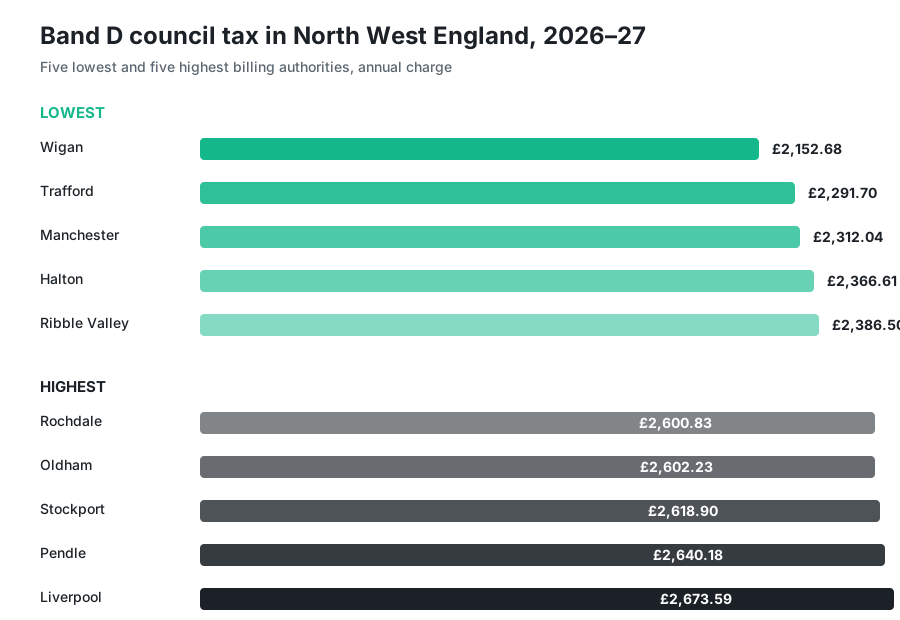
The short answer: across the 35 North West billing authorities in REalm’s 2026–27 dataset, annual Band D council tax runs from £2,152.68 in Wigan to £2,673.59 in Liverpool. That is a difference of £520.91 a year, or about £43.41 a month when averaged over 12 months. The simple, unweighted average across the authorities is £2,483.22.
That regional comparison is useful, but it is not a quote for a particular home. Your actual bill depends on the property’s council tax band, its exact billing authority and parish, who lives there, any discounts or exemptions, and whether an empty-home or second-home premium applies.
For buyers comparing homes in Manchester, Liverpool, Lancashire, Cheshire or Cumbria, council tax belongs in the affordability calculation alongside the mortgage, insurance, energy, service charges and maintenance. A lower purchase price does not automatically mean a lower council tax bill, and two nearby homes can fall into different bands.
REalm buyer takeaway: check the band and the council’s current charge for the exact address before making your final monthly budget. Do not rely only on an estate-agent listing or on the average for the town.
North West council tax rates at a glance
| 2026–27 Band D measure | Annual amount | 12-month equivalent |
|---|---|---|
| Lowest in dataset: Wigan | £2,152.68 | £179.39 |
| Highest in dataset: Liverpool | £2,673.59 | £222.80 |
| Simple average of 35 authorities | £2,483.22 | £206.94 |
| Median authority | £2,488.25 | £207.35 |
| Highest-to-lowest gap | £520.91 | £43.41 |
Method note: the average is an unweighted mean of billing-authority figures. It does not adjust for the number or mix of homes in each authority and should not be confused with an official household-weighted regional average. Monthly equivalents divide the annual figure by 12; many bills are normally collected over 10 instalments unless a 12-month arrangement is requested.
Where Band D charges are lowest
On the standard Band D comparison, Wigan is the lowest-cost authority in the dataset at £2,152.68 a year. Trafford follows at £2,291.70, then Manchester at £2,312.04. These three are all in Greater Manchester, but the pattern is not uniform across the city region: Stockport’s Band D figure is £2,618.90, £466.22 more than Wigan’s.
Ten lowest Band D council tax rates, 2026–27
| Rank | Billing authority | Annual Band D | 12-month equivalent |
|---|---|---|---|
| 1 | Wigan | £2,152.68 | £179.39 |
| 2 | Trafford | £2,291.70 | £190.98 |
| 3 | Manchester | £2,312.04 | £192.67 |
| 4 | Halton | £2,366.61 | £197.22 |
| 5 | Ribble Valley | £2,386.50 | £198.88 |
| 6 | Bolton | £2,399.74 | £199.98 |
| 7 | St Helens | £2,403.38 | £200.28 |
| 8 | Chorley | £2,430.23 | £202.52 |
| 9 | South Ribble | £2,442.66 | £203.56 |
| 10 | Tameside | £2,447.21 | £203.93 |
This is not a ranking of the “best” places to buy. Council tax is only one recurring cost, and a modest tax saving can be outweighed by a different purchase price, commute, service charge, insurance premium or renovation requirement. It is better used as a budget-checking tool than as a location shortlist on its own.
Where Band D charges are highest
Liverpool has the highest Band D charge in the dataset at £2,673.59 a year, followed by Pendle at £2,640.18 and Stockport at £2,618.90. For a household paying the full standard amount, Liverpool’s Band D figure is about £222.80 per month when spread evenly over 12 months.
Ten highest Band D council tax rates, 2026–27
| Rank | Billing authority | Annual Band D | 12-month equivalent |
|---|---|---|---|
| 1 | Liverpool | £2,673.59 | £222.80 |
| 2 | Pendle | £2,640.18 | £220.02 |
| 3 | Stockport | £2,618.90 | £218.24 |
| 4 | Oldham | £2,602.23 | £216.85 |
| 5 | Rochdale | £2,600.83 | £216.74 |
| 6 | Salford | £2,594.45 | £216.20 |
| 7 | Sefton | £2,583.22 | £215.27 |
| 8 | Preston | £2,575.74 | £214.65 |
| 9 | Bury | £2,555.15 | £212.93 |
| 10 | Burnley | £2,549.42 | £212.45 |
The dataset’s named subregions also show variation. The unweighted Band D averages are £2,457.49 across ten Greater Manchester authorities, £2,492.88 across twelve Lancashire authorities and £2,529.81 across five Merseyside authorities. Eight unitary authorities have no usable subregion value in the supplied file, so they are included in the North West total but excluded from those subregional averages.
How council tax bands work in England
Every domestic property is assigned a band from A to H by the Valuation Office Agency. In England, the band is based on what the property could have sold for on 1 April 1991, not its present-day market value. The official thresholds are:
| Band | Assessed value at 1 April 1991 | Charge relative to Band D |
|---|---|---|
| A | Up to £40,000 | 6/9 |
| B | £40,001–£52,000 | 7/9 |
| C | £52,001–£68,000 | 8/9 |
| D | £68,001–£88,000 | 9/9 |
| E | £88,001–£120,000 | 11/9 |
| F | £120,001–£160,000 | 13/9 |
| G | £160,001–£320,000 | 15/9 |
| H | More than £320,000 | 18/9 |
Band D is the standard comparison measure. The other bands are fixed proportions of it. In Wigan, for example, the dataset shows £1,435.12 for Band A and £4,305.36 for Band H. In Liverpool, it shows £1,782.39 for Band A and £5,347.18 for Band H.
This explains why the asking price cannot tell you the bill. A home selling for £300,000 today is not automatically placed in the band whose 1991 threshold looks closest to £300,000. Its band reflects the statutory historic valuation basis and comparable-property evidence.
Why neighbouring homes can have different bills
Council tax varies at two levels. First, local authorities set different Band D amounts, reflecting the council tax requirement, tax base and relevant precepts. Second, each home has its own valuation band. Parish or town council precepts can also produce address-level differences inside a wider billing-authority area.
Similar-looking homes may differ because of size, layout, age, position or historic alterations. A major extension can also lead to a band review, often when the property is sold. This is why buyers should verify the address itself rather than assuming it matches the house next door.
If a band seems wrong, the official route is through the Valuation Office Agency. A challenge needs evidence, and the outcome can be a lower band, no change or a higher band. Buyers should therefore treat a challenge as a formal valuation process, not as a guaranteed saving, and continue paying the existing bill while it is considered.
What should a buyer check before making an offer?
Use this practical council tax checklist:
- Look up the property’s band. Use the official GOV.UK council tax valuation-list service and search by postcode or address.
- Confirm the current charge. Check the billing authority’s 2026–27 schedule for that band and exact parish or locality.
- Ask for the latest bill. It can reveal the band, instalment pattern and applied reductions, but remember that the seller’s personal discount may not transfer to you.
- Model the full annual amount first. Budget from the gross charge, then apply only discounts or exemptions you are confident you can claim.
- Check occupancy. A full bill assumes at least two counted adults. A sole counted adult will normally need to apply for the 25% single-person discount.
- Investigate recent alterations. Ask whether the property has been extended, subdivided, merged or converted, and whether a band review marker or reassessment may be relevant.
- Check second-home and empty-home rules. Investors, renovators and buyers with overlapping ownership periods should ask the council about premiums and exceptions.
- Allow for annual changes. Council tax is reset for each financial year, so a completion near April can coincide with a new bill.
For affordability, convert the annual amount to both a 10-instalment and 12-month view. A £2,400 annual bill is £240 across ten instalments, or £200 across twelve. GOV.UK says bills are usually split into ten monthly payments, but households can ask their council to spread payment over twelve months. The annual liability is unchanged; the cash-flow profile is smoother.
Discounts, exemptions and premiums buyers should know
A standard bill assumes at least two counted adults living in the property as their main home. If only one counted adult lives there, or everyone else is disregarded, the payer can usually apply for a 25% discount. Some people, including qualifying full-time students, may be disregarded; households where everyone is disregarded may receive a different reduction or exemption depending on the circumstances. These reductions are not automatic, so the liable person should apply to the council.
Second homes and empty properties need special attention. English councils can charge a second-home premium, and long-term empty homes can attract escalating premiums. Exceptions can apply, for example in specified probate, active marketing, major-repair, job-related or annex circumstances, but the rules and evidence matter. A buyer planning renovation should never assume that “empty” means “council-tax free”.
People on a low income may qualify for local Council Tax Reduction. Schemes vary by council, so a buyer should check the relevant authority rather than using another area’s entitlement calculator.
Is lower council tax a reason to choose one North West area over another?
It can influence the budget, but it rarely outweighs the whole property decision. The £520.91 Band D gap between Wigan and Liverpool is meaningful: over five years, holding 2026–27 charges constant purely for illustration, it would total about £2,604.55. In reality, annual charges will change, and the two homes may differ much more in purchase price, mortgage interest, transport costs or maintenance.
A more useful REalm comparison is total housing cost:
mortgage or rent + council tax + service charge/ground rent where applicable + buildings and contents insurance + energy + commuting + realistic maintenance
For leasehold flats, service charges can dwarf council tax differences. For older houses, maintenance and energy performance can be larger swing factors. For commuters, a season ticket or car journey may dominate. Council tax should be visible in the decision, but never isolated from it.
What happens when you complete your purchase?
Council tax liability changes with occupation and ownership, so buyers should tell the council promptly after completion. The authority will normally ask for the property address, completion date, the names of the new residents and details of the previous address. It will then open the new account and issue a bill for the relevant part of the financial year.
The seller’s bill is not a reliable forecast of the buyer’s net payment. A seller may have received a single-person discount, student disregard or Council Tax Reduction that does not transfer with the property. Conversely, a buyer living alone may qualify for a reduction that was not shown on the seller’s account. The safest affordability calculation starts with the full charge for the property’s band and treats any reduction separately.
There is no general council tax discount for first-time buyers. A first-time buyer may qualify for the same occupancy- or income-related support as anyone else, but the purchase itself does not create an entitlement.
Completion close to the start of April deserves extra care because council tax is set by financial year. The previous year’s figure may still appear in a property listing or old bill even though a new schedule applies. Buyers should use the figure for the year in which they will become liable and leave some room for later annual increases.
Put the comparison in context
The government’s official average Band D council tax for England in 2026–27 is £2,392. The simple average across the 35 North West authorities in REalm’s dataset is £2,483.22, about £91 higher. These figures are not perfectly like-for-like: the national statistic is an official average based on the council tax requirement and tax base, while the REalm figure is an unweighted average in which every billing authority counts once. It is best read as a guide to the range of published local charges, not as an estimate of what the typical North West household pays.
Band D itself is also a benchmark rather than a description of the region’s housing stock. Many households live in bands A to C and pay the corresponding fraction of their authority’s Band D rate. Others pay less because of discounts or support, while empty and second homes can face premiums. The tables are therefore most useful when a buyer already knows the band of a particular property.
The bottom line for North West property buyers
North West council tax is not one regional price. The 2026–27 Band D figures in this dataset span more than £500 a year, and the actual cost of a chosen home can move further according to its band, parish, occupancy and any premiums.
Before committing to a purchase, verify three things: the exact address’s band, the exact local charge and the reductions or premiums that will apply to your household. Add the resulting annual figure to your full cost-of-ownership budget. That small piece of due diligence produces a much more realistic view of affordability, and fewer surprises after completion.
Sources and notes
- Government context: Council Tax levels set by local authorities in England 2026–27; how Council Tax bands are assessed; check a Council Tax band; who has to pay and discounts; paying your bill; second homes and empty properties; challenge a Council Tax band.
- Core dataset: 35 North West billing authorities, tax year 2026–27, based on MHCLG Tables 1–9 published 25 March 2026.
- Figures are rounded to the nearest penny. “Monthly equivalent” means annual charge divided by 12, not necessarily the billed instalment.
- This article is general information, not tax, financial or legal advice. Readers should confirm address-specific charges and eligibility with the relevant council and the Valuation Office Agency.